Yakov Trembovolsky, it's so interesting, isn't it!)) So many stories inside)) Although, of course, then we wouldn't have such an overall, orderly, and rhythmic picture.
Yakov Trembovolsky, it's interesting, isn't it!)) So many stories inside)) Although, of course, then we wouldn't have such an overall, orderly, and rhythmic picture.. #3 12/21/2016 11:55 AM
Sergey Krasnoperov,
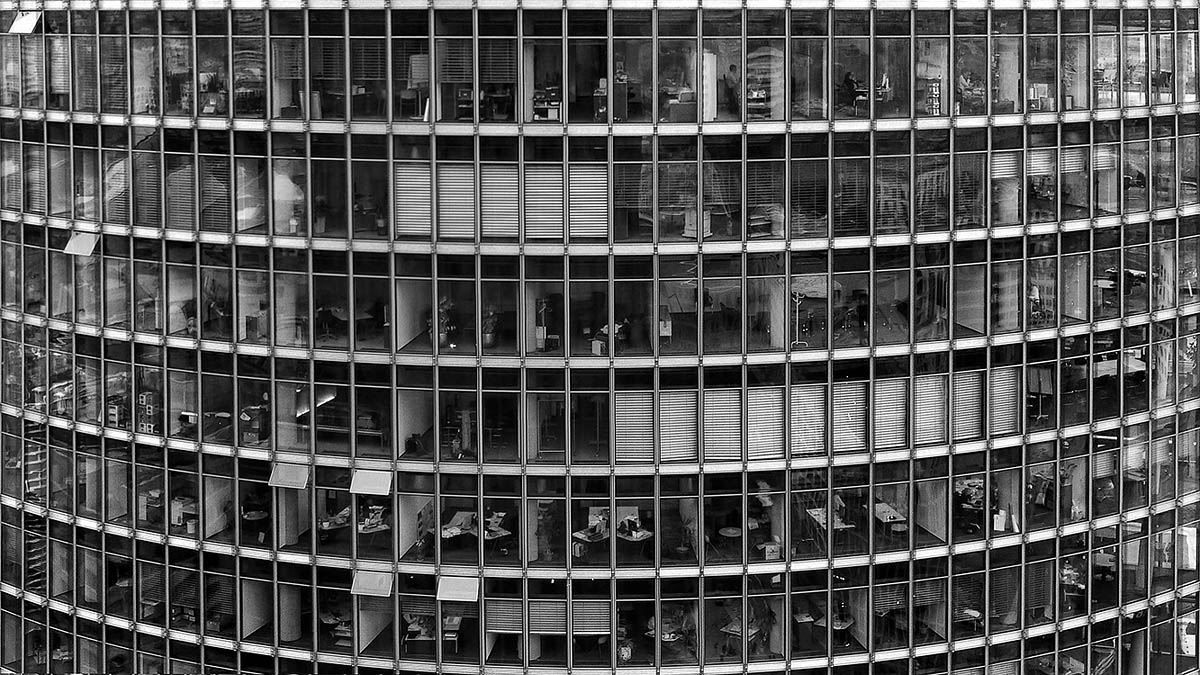
Yes. It's a kind of "theater." Everyone in their own "honeycomb" lives their own individual office life (whether there's a person in the room or not). We can guess at the degree of individuality.
But an outsider's perspective paints a different picture: one of maximum generality and similarity. A different philosophy.
Therefore, the more such honeycombs in the picture, the more precise the concept. And it's good that there are blinds on the windows.
I'm of the opinion that life is like living in a beehive or an anthill. Just as you can observe bees and ants for a long time, you can observe them here, looking for interesting moments!
Clearly inspired by the works of Andreas Gursky, the blocks are arranged into a monumental abstraction. If you zoom out significantly, the work would resemble the work of Jackson Pollock.
When I posted it in color, Gursky was mentioned in the discussion, of course. The quote is obvious. )
Yakov Trembovolsky, Yeah, I'm not accusing him, it's just a reference...that's what I noticed. The work is interesting. Gursky's signature feature is the size (monumentality), but your version shifts the emphasis somewhat differently...closer to Pollock's work.
Yes, I'm not accusing you, it's just a reference...that's what I noticed. The work is interesting. Gursky's highlight is the size (monumentality), but your version shifts the emphasis somewhat differently...closer to Pollock's work.
Alexander Zeonoff,
I understand and agree. Yes, there is a similarity. The connection with Pollock is a bit contrived: any repetition of iconic signs, if you remove the iconicity, is reminiscent of the works of abstract artists. To a greater extent, even of Op-Artists, like Vasarely.


:))
The details aren't important. They're just symbols. I wanted to glue four of these fragments together.
In principle, I can. I have the materials.))
Yes. It's a kind of "theater." Everyone in their own "honeycomb" lives their own individual office life (whether there's a person in the room or not). We can guess at the degree of individuality.
But an outsider's perspective paints a different picture: one of maximum generality and similarity. A different philosophy.
Therefore, the more such honeycombs in the picture, the more precise the concept.
And it's good that there are blinds on the windows.
And you can look at it for a long time...)
A very interesting work.
When I posted it in color, Gursky was mentioned in the discussion, of course.
The quote is obvious.
I understand and agree. Yes, there is a similarity.
The connection with Pollock is a bit contrived: any repetition of iconic signs, if you remove the iconicity, is reminiscent of the works of abstract artists.
To a greater extent, even of Op-Artists, like Vasarely.